.png)
The Iran Case: Blocked Entry, Canceled Visas — Why Investors Are Turning to Turkey's Passport
The Fragility of a Single Identity: Why Geopolitical Hedging is No Longer Optional

As of March 28, 2026, new entry and transit restrictions for Iranian nationals in Dubai—even those with valid UAE residency—have sent shockwaves through the global mobility market. For those relying on a single nationality, these sudden shifts are more than an inconvenience; they represent a fundamental "single-identity risk" that can paralyze international business and personal freedom overnight.
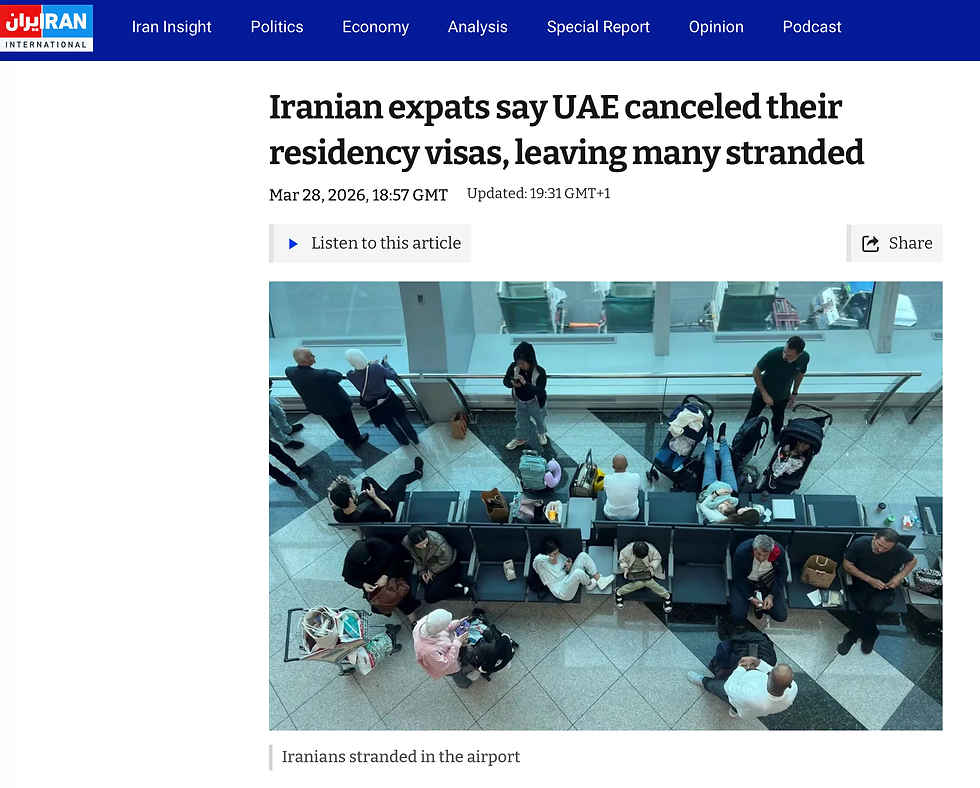
Recent reports of UAE Golden Visa cancellations have further fueled this anxiety. While much of this remains speculative, the mere discussion has triggered a paradigm shift among high-net-worth individuals (HNWIs). At Globevisa, we are seeing a clear transition: multiple citizenships are no longer viewed as a luxury, but as a strategic necessity.
From ROI to Capital Protection
For decades, the primary metric for investment migration was ROI. Today, that has been replaced by a more existential concern: “Will my assets and residency rights survive a geopolitical crisis?”
We saw this play out during the Russia-Ukraine conflict, where private assets were frozen based solely on nationality, regardless of individual standing. This highlighted a brutal reality: in times of tension, your investment’s safety is tethered to your host country’s foreign policy.
Why Turkey Remains Resilient
1.Stability Amidst Volatility
We experienced similar waves of concern during the large depreciation of the Turkish lira in 2023–2024. Many investors contacted us with questions and worries about the safety of their funds. Despite economic volatility, political debates, inflation, and a complex geopolitical environment, the Turkish Citizenship by Investment program continued to operate under the same legal framework. Investors obtained their passports and were able to withdraw their funds after the required holding period without any legal obstacles. Turkey has also taken a different approach compared with some other jurisdictions during geopolitical conflicts. Even during periods of major international tension, such as the Russia–Ukraine war, Turkey did not freeze or seize private investor funds in the way that some Western jurisdictions did through sanctions mechanisms.
2. The "Major Country" Advantage and Identity Transformation
When comparing citizenship-by-investment programs, many are now prioritizing the "Major Country" status that Turkey provides. Although the overall processing cycle is approximately 7-9 months—which may not be as fast as some small island nation programs—the resulting passport carries significantly more geopolitical weight.
Through this process, applicants achieve a legal identity transformation. Once a person’s legal status changes to that of a Turkish citizen, they are no longer subject to the specific restrictions or administrative hurdles targeted at their original nationality.
3.Practical Mobility and Diplomatic Stability
This identity shift has direct practical benefits for international travel and residency. For instance, Turkish passport holders applying for UAE visas or transiting through Dubai typically do not face the same policy uncertainties. This is closely linked to the relatively stable and strategic diplomatic relations currently maintained between Turkey and the UAE, providing a layer of protection that residency alone cannot offer.
Conclusion: Beyond Financial Returns
In a fragmented world, the most valuable asset isn't just liquidity—it’s predictability. Choosing a jurisdiction like Turkey is a move toward sovereign diversification. For the modern investor, the goal is to ensure that when the geopolitical map changes, their world doesn't have to stop.



Comments