.png)
Myth Busted! "Green Card Adjustment Ban in the U.S." Does Not Apply to Everyone
On May 22, the U.S. Citizenship and Immigration Services (USCIS) issued a memorandum (Adjustment of Status and Discretion) that broadly tightened the I-485 adjustment of status process within the United States, causing significant upheaval in the industry.
"Can I still file an I-485 inside the U.S.?"
"Will leaving the U.S. now have an impact?"
"Will an already filed I-485 be denied?"
Various questions and misinformation flooded the internet. Some self-media outlets jumped to conclusions without in-depth research, publishing inaccurate statements such as "I-485 cannot be filed in the U.S.," causing anxiety and panic among applicants.
Globevisahas been deeply involved in U.S. immigration for over 15 years and has experienced multiple policy changes. The more sudden the situation, the more calmly we must respond. Our in-house legal team immediately discussed the legal feasibility and potential impacts with several top U.S. immigration attorneys. We also invited Carolyn, a prominent immigration attorney who is the President of the American Immigration Lawyers Association (AILA) and a participant in EB-5 legislation, to our GlobevisaLive studio to speak face-to-face with applicants, providing professional and authoritative interpretations.
How to Understand the Latest USCIS Memorandum?
Attorney Carolyn pointed out that the new memorandum does not change the legal provisions of the Immigration and Nationality Act (INA) regarding adjustment of status, but it sends an important signal to the public and immigration officers: adjustment of status in the U.S. is a discretionary act, not a right of the applicant, and USCIS will review applications more strictly. This means that in the future, when adjudicating I-485s, USCIS can no longer maintain the past "accept-all-comers" standard. Instead, I-485 should be granted as a "special favor" to those truly deserving. For most non-immigrant visa applicants, in principle, they should go through the consular process in their respective countries.
The New Memorandum Does Not Apply to Everyone
On May 22, the mainstream U.S. business media outlet Business Insider reported that "the Trump administration indicated that the new green card enforcement is unlikely to apply to those who provide 'economic benefits.'"

USCIS spokesperson Zach Kahler stated in an interview:
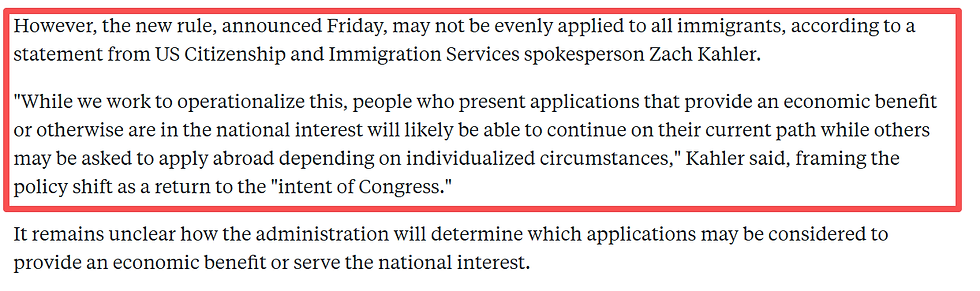
The new rule does not apply to everyone. Individuals who file applications, can bring economic benefits, or align with the overall national interest are likely able to continue with their current path.
Attorney Carolyn also mentioned during the live broadcast that EB-5 investment immigration brings capital injection and job creation to the U.S., aligning with U.S. national interests, and is therefore likely not to be affected by this memorandum.
Attorney Carolyn Answers Other Common Questions
Q: Can the memorandum be overturned?
A: Carolyn revealed that groups are discussing filing lawsuits, but since the memorandum was just released, it has not yet been overturned.
Q: Will the EB-5 concurrent filing mechanism be eliminated?
A: Carolyn clearly stated that the memorandum does not affect the concurrent filing process or mechanism. All requirements and procedures remain unchanged. Concurrent filing is still feasible.
Q: Will the memorandum affect I-526E approvals and green card recipients?
A: Carolyn indicated that the memorandum only involves adjustment of status (I-485) and does not affect the adjudication of I-526E (EB-5 green card qualification application) nor applicants who have already obtained conditional green cards.
Q: Will the memorandum affect work permits (EAD) or advance parole (AP)?
A: Carolyn explained that the memorandum itself does not directly address I-765 (EAD) or I-131 (AP), but immigration officers will conduct stricter background checks. If the applicant has adverse records in the U.S., such as an arrest, it may affect the issuance of the EAD/AP. If a Combo card (EAD+AP) has already been obtained and activated, it remains valid, but leaving the U.S. is not currently recommended. If the I-485 is denied, the Combo card becomes invalid. If the Combo card has not yet been activated, you may temporarily refrain from activating it and retain another non-immigrant status to wait and see.
Q: If an I-485 is denied, are there remedies?
A: Carolyn confirmed that after an I-485 denial, the applicant can file Form I-824 to have the case transferred to a consulate abroad (e.g., Guangzhou) to continue the immigrant visa process.
Q: Risk analysis of the memorandum for different visa holders:
A: Carolyn stated that H-1B and L-1 visa holders have "dual intent" and are generally less susceptible to immigrant intent challenges, so they are less affected. However, those with violations or immigration violations may still be denied. Applicants intending to enter on a B visa or F visa and file concurrently after 90 days need to carefully assess their situation and not rush to file an I-485.
Globevisahas served over 5,000 families in the EB-5 immigration field and has extensive experience responding to various policy adjustments or changes. With service institutions in both China and the U.S., an in-house legal team, and strategic partnerships with top law firms nationwide, we have the capability to obtain accurate and authoritative information promptly, provide professional interpretations, follow policy developments in real time, flexibly adjust exclusive response plans based on each applicant's unique situation, and steadily and efficiently advance the entire immigration application process.



Comments