.png)
Invest €100,000 for a European Residency: Why Latvia Is Quietly Gaining Attention Again
- Daisy Ma
- 17 hours ago
- 7 min read
Over the past few years, Europe’s investment migration landscape has been changing rapidly. Countries once considered the stars of the Golden Visa market—Portugal, Greece, and Spain—have either tightened their requirements or phased out some of their most popular investment routes. Yet this does not mean Europe has become less welcoming to international investors.
What has changed is the definition of investment itself.
The era of simply purchasing a property or placing capital into a passive asset and waiting for residency approval is gradually fading. Across Europe, policymakers are paying closer attention to factors such as business activity, job creation, tax contributions, and long-term economic participation. As a result, investment programs that demonstrate a tangible benefit to the local economy are increasingly being viewed more favorably.
Against this backdrop, Latvia has begun attracting renewed interest. While many European residency programs are undergoing significant adjustments, Latvia has seen application numbers increase by more than 50%, making it one of the more closely watched destinations in today’s market.
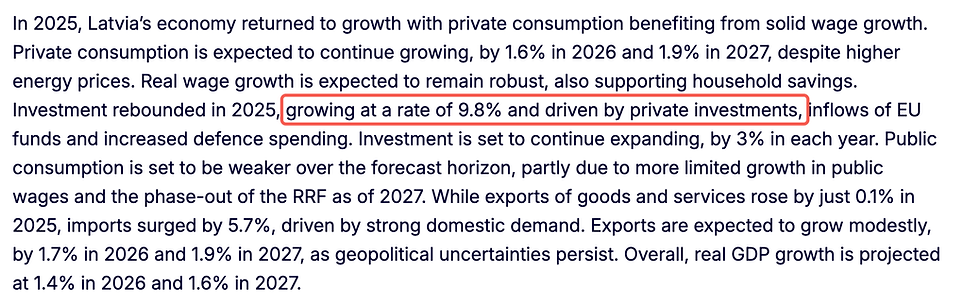
According to the European Commission's latest economic forecast, investment in Latvia grew by 9.8% in 2025. The growth was driven by private investment, continued inflows of EU funding, and increased infrastructure spending. Investment activity has returned to a growth trajectory, with further expansion expected in the coming years. At the same time, the country continues to invest in digital transformation, infrastructure development, and innovation-driven industries.
For a country with a population of fewer than two million people, maintaining economic momentum requires a steady inflow of capital, businesses, and talent. Latvia understands this reality well.
Located on the Baltic Sea, Latvia holds membership in the European Union, the Schengen Area, the Eurozone, and NATO. Each of these affiliations is significant on its own. Together, they place Latvia firmly within the core political, economic, and financial framework of Europe.
And perhaps that is what makes Latvia particularly interesting today. It may not generate as many headlines as some of Europe's larger economies, but it is deeply integrated into the institutions and systems that shape the continent's future.

A Residency Framework Designed Around Real Economic Activity
The legal foundation of Latvia's €100,000 corporate investment residency route can be found in Section 28 of the Latvian Immigration Law. Under this provision, foreign investors may apply for a residence permit by investing in a qualifying Latvian company.
For the large-enterprise investment route, the law requires an investment of €100,000 in exchange for company shares. Successful applicants may obtain a residence permit valid for up to five years, with the possibility of renewal. At the same time, the receiving company must satisfy a series of requirements, including maintaining at least 50 employees, achieving an annual turnover or balance sheet total of no less than €10 million, and meeting prescribed tax contribution thresholds.
On paper, this appears to be a standard investment residency program. A closer look, however, reveals a broader policy objective.
For Latvia, attracting capital has never been solely about increasing financial inflows. The country's approach places greater emphasis on directing investment into operating businesses—companies that create jobs, pay taxes, and contribute to long-term economic growth. In other words, Latvia is not seeking capital that simply sits on a balance sheet. It is encouraging investment that becomes part of the real economy.
This philosophy is reflected in the legal requirements themselves. A qualifying company must do more than meet a minimum investment threshold. It must maintain genuine business operations, employ local staff, and continue fulfilling its tax obligations. Companies that satisfy these criteria are generally established enterprises with ongoing commercial activity, rather than entities created solely to facilitate residency applications.
In many ways, Latvia's framework mirrors a wider trend emerging across Europe. As governments reassess traditional Golden Visa models, there is growing preference for investment structures that support business development and economic participation rather than passive asset ownership.
The €100,000 corporate investment route was developed within this context.
Rather than relying on property purchases or speculative asset holdings, it offers a residency pathway linked directly to the growth of real businesses and the broader Latvian economy. For investors seeking a long-term European foothold, that distinction may become increasingly important in the years ahead.
Who Is Using Latvia to Build a European Future?
Latvia's investment residency program is not designed for a particular profession or age group. Instead, it appeals to individuals and families seeking a practical and long-term route into Europe. For many applicants, this is about far more than residency—it is part of a broader plan for their family's future.
▶ Ideal for Business Owners and Investors
Entrepreneurs, company owners, and experienced investors who wish to diversify their international footprint and establish a European residency option.
▶ Ideal for Education-Focused Families
Families looking to create future opportunities for their children, whether in education, international exposure, or long-term overseas development.
▶ Ideal for Long-Term Residency Planners
Individuals who do not intend to relocate immediately but would like to secure a European residency pathway in advance and keep future options open.
By investing €100,000 in shares of a qualifying Latvian company, applicants may obtain a five-year residence permit and include their spouse and children in the application. The overall process typically takes 3–4 months, with approvals issued in as little as 5 days and residence cards obtainable within 2 days after the biometric appointment.
Why Latvia? Five Reasons Investors Are Taking a Closer Look
When people think about European residency, countries such as Portugal, Greece, and Spain usually come to mind first. Latvia rarely dominates the conversation—and that may be precisely part of its appeal.
Situated on the Baltic coast, Latvia is a member of the European Union, the Schengen Area, the Eurozone, and NATO. While it may not be Europe's largest or most talked-about country, it is fully integrated into the continent's core political, economic, and financial systems. For many internationally minded families, that foundation matters far more than short-term market trends.
✓ Greater Flexibility, Without Disrupting Your Current Lifestyle
One of the most common concerns among investors is not the investment amount itself, but the lifestyle changes that may follow.
The reality is that most applicants do not intend to relocate to Europe immediately. They may still be running businesses, managing investments, or raising families in their home country. A residency program that demands extensive physical presence can quickly become difficult to maintain.
Latvia offers a different approach. The corporate investment route allows investors to establish a European residency foothold without fundamentally changing their existing lifestyle. There is no need to relocate full-time, restructure a business, or shift the center of one's personal and professional life. For many families, this creates an opportunity to secure a European option today while keeping future plans open.
✓ A Family-Oriented Solution
Residency planning is rarely an individual decision. In most cases, it is a family decision. Through Latvia's investment residency program, spouses and dependent children can apply together with the main applicant. Whether the goal is future educational opportunities, greater international mobility, or simply having additional options available down the road, a family-based approach provides significantly more flexibility. Many investors are not seeking immediate change. They are creating choices for the future.
✓ Access to Europe—Not Just Latvia
For many applicants, Latvia is only part of the equation. A Latvian residence permit provides access to the wider Schengen Area, allowing holders to travel freely across 29 European countries. For business owners, this can mean easier access to European markets and more convenient international travel. For families with long-term educational plans, it opens the door to a broader international environment. From this perspective, the investment is made in Latvia, but the opportunities extend well beyond Latvia itself.
✓ A Competitive Entry Point and Fast Processing
Europe's investment migration market has become increasingly selective. Portugal has removed its real estate Golden Visa route. Spain has brought its Golden Visa program to an end. Greece has raised investment thresholds in several regions. Across the continent, entry requirements have generally moved in one direction—upward.
Against this backdrop, Latvia's €100,000 corporate investment route remains relatively accessible. Processing efficiency is another notable advantage. While some European residency programs may take many months—or even longer—from submission to approval, Latvia has built a reputation for speed. When all required documentation is in place, approvals are often issued within 5 to 30 days, allowing applicants to move quickly to the next stage of the process.
✓ More Than a Five-Year Residence Permit
A five-year residence permit is only the starting point. Subject to meeting the relevant legal requirements, residency status may be renewed and can potentially form part of a longer-term pathway toward permanent residence and, ultimately, citizenship.
For investors thinking beyond the immediate future, this is often the more important consideration. The value lies not only in obtaining a residence card today, but in securing a structured and clearly defined route that can support future family, business, and international mobility plans.
In a market where many traditional options have become more restrictive, Latvia offers something increasingly difficult to find: a practical European residency solution built on a relatively modest investment threshold, a straightforward legal framework, and long-term flexibility.
Choosing the Right Program Matters. Choosing the Right Team Matters Too.
Many people assume that residency planning is simply a matter of collecting documents, signing forms, submitting an application, and waiting for a result. The reality is often far more complex.
Which company should you invest in? How should supporting documents be prepared? Which materials require advance planning? What details could affect the approval process? These are the kinds of questions that arise throughout the journey. While the program itself is important, the overall experience often depends on how effectively each stage is managed.
That is why more and more applicants are paying attention not only to the program they choose, but also to the team guiding them through it.
For more than two decades, Globevisa has focused on European residency and citizenship planning. Today, the company operates over 50 offices worldwide and has assisted more than 120,000 families with their international mobility goals.
Numbers alone do not tell the whole story, but they do reflect extensive experience working with clients from a wide range of backgrounds and navigating countless real-life cases.
For Latvia's investment residency program, Globevisa provides end-to-end support throughout the process—from initial assessment and company matching to document preparation, application submission, and ongoing case management. Every application is approached individually, with solutions tailored to each client's circumstances and objectives.
Transparency is equally important. All fees are clearly outlined before engagement, including payment recipients, service scope, and associated costs, ensuring that clients have a full understanding of the process from the very beginning.
Residency planning is rarely a one-time transaction. For many families, it is a long-term strategy that unfolds over several years. In that context, the program itself is only one part of the equation. Equally important is working with a team that understands the regulations, procedures, and local landscape—and can help navigate them with confidence.


Comments