.png)
Henry's Perspective on Hong Kong III | Lantau Island and Tai O: Beyond Central to Fishing Villages, Islands, and Trails
Hello, everyone.
In my previous two posts, I discussed the Hong Kong Trail and the MacLehose Trail. For this installment, I want to wrap up my "mountains and seas" series by talking about Lantau Island and the Lantau Trail.
I swear, after this article, I will stop talking exclusively about mountains, trail races, and running. Otherwise, you might start to think this isn't a series about Hong Kong, but rather a journal on the self-cultivation of a trail runner.
But I can't help it. Many of my deepest memories of Hong Kong are inherently tied to its mountains. And if we are talking about Hong Kong's mountains, we absolutely cannot skip Lantau Island.
01. Hong Kong Has Many Islands, and the "Island Life" Fascinated Me
Hong Kong is surrounded by outlying islands.
When I first moved here, I made a point to visit as many of them as possible. Looking back, I can barely remember all their names, but a few places left a lasting impression, such as Lamma Island.
My first trip to Lamma Island felt incredibly refreshing. It takes just over twenty minutes by ferry from Central. The island has two main piers; you can start at one, hike along the mountain path, pass small beaches, catch a few tiny crabs, and eventually arrive at the other pier to eat fresh seafood before taking the ferry back to the city.

I was completely fascinated by these outlying islands when I first arrived. They revealed an entirely different way of life in Hong Kong: no skyscrapers, no subways, no commercial office buildings. Instead, there were boats, the ocean, small villages, seafood, mountain trails, dogs, and a highly rustic, natural lifestyle.
I often saw expats who lived on Lamma Island. They would take the twenty-minute ferry to Central for work in the morning and return to their island life at night. I thought that was a fantastic way to live.
The distance between the city and nature is remarkably short. You can work in a global financial hub during the day and return to a quiet, island-like retreat at night. This is one of the most magical aspects of Hong Kong: it seamlessly houses both highly modernized and wonderfully rustic lifestyles within the exact same city limits.
02. I Almost Moved to Discovery Bay
You cannot talk about Lantau Island without mentioning Discovery Bay.
Many people unfamiliar with Hong Kong don't even know this place exists. But when I first arrived, I desperately wanted to live there.
Discovery Bay is a meticulously developed residential community. Private cars are generally not allowed; residents rely on ferries, walking, buses, and golf carts. The entire area exudes a resort-like atmosphere—complete with a beach, restaurants, mountains, active residents, and a large population of expatriate families.
I have always gravitated toward this type of community vibe. When I worked in Beijing, I lived in Central Park and grew accustomed to a lifestyle that was international, sports-oriented, and filled with cafes and public spaces. So, the first time I saw Discovery Bay, my immediate thought was:
Isn't this exactly the lifestyle I've been picturing?
People sit at seaside restaurants looking out at the water. The community is full of movement—people running, walking dogs, pushing strollers. It doesn't feel like a traditionally crowded Hong Kong neighborhood; rather, it feels like a complete, self-sustaining seaside ecosystem.
Ultimately, I didn't move there for a very practical reason: the waitlist for the local international school was simply too long for my kids. If we had secured spots at that school back then, I almost certainly would have lived there.
So you see, my appreciation for Hong Kong goes far beyond the superficial "tourists think it's fun" level. I genuinely and carefully considered which version of Hong Kong I wanted to anchor my life in. And Discovery Bay was the Hong Kong I very nearly chose.
03. The Golf Course Showed Me Hong Kong's Sense of Family
Even though I didn't move to Discovery Bay, I still visit frequently. One of the main reasons is golf.
Hong Kong doesn't have an abundance of golf courses, but Discovery Bay has one that suits us perfectly. A somewhat rare trait of our family is that we all play golf. I have played for years, but I almost never play with outsiders; I play exclusively with my family. Spending weekends golfing in Discovery Bay is one of my favorite aspects of living in Hong Kong.
Playing golf here gives me a very distinct impression: the family atmosphere is incredibly strong.
When playing in mainland China, I rarely saw couples paired up on the course. It was usually a business setting, filled with entrepreneurs, clients, or networking groups. But in Discovery Bay, the people I am grouped with are frequently husbands and wives. You see mothers playing with sons, fathers with daughters, as well as a diverse mix of Koreans, Indians, locals, and professionals like doctors and lawyers.
I find this fascinating. Here, golf isn't just business networking; it is a genuine family sport.
Furthermore, playing here requires a strong sense of order. There are no caddies, so you have to handle everything yourself. You carry your own bag, find your own balls, and manage your own pace—ensuring you don't hit into the group ahead or hold up the group behind. Everyone is highly self-disciplined. This blend of orderliness and family orientation is another reason I love this city.
04. The Lantau Trail: My First Solo 100-Kilometer Race
Moving from Discovery Bay back to the trails, let's talk about the Lantau Trail. It is a classic long-distance route that circles Lantau Island, covering about 70 kilometers.
My deepest memory of this trail comes from a race called TransLantau. This was the first time I completed a 100-kilometer trail race entirely on my own. (My first 100km was the Trailwalker on the MacLehose Trail, but that was a four-person team event). TransLantau was my first time truly facing a long-distance ultramarathon solo.
Two things from that race remain vivid in my mind.
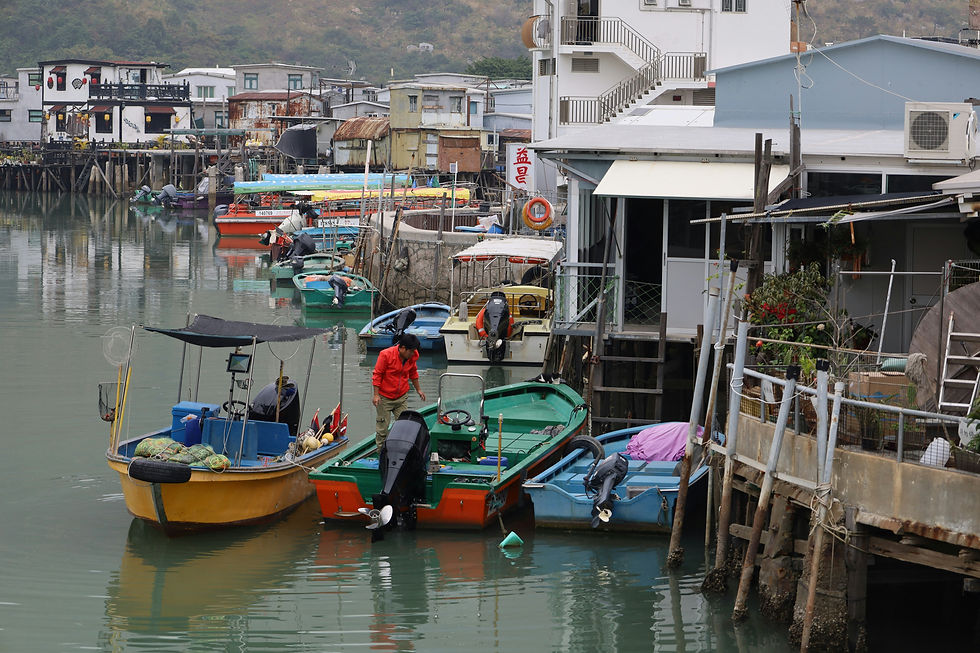
First, I was running along and suddenly found myself in Tai O. Tai O is a famous, historic fishing village in Hong Kong. I knew of it and had visited once before, but I had no idea it was on my race route. I had already run about 50 kilometers and was dead tired. Suddenly, I popped out of the mountains, and right in front of me was a fishing village. People were drying salted fish, small shops were open, and vendors were selling breakfast—including fried dough sticks (youtiao) and savory tofu pudding.
I was completely dumbfounded. Imagine running dozens of kilometers through the wilderness, only to suddenly emerge into an ancient fishing village, smell salted fish, watch locals going about their morning routines, and see breakfast stalls. It was an incredibly surreal experience.
The second lasting memory was the rain during the second half of the race. It was my first time racing in the rain. Lacking experience, I didn't manage my shoes, socks, or toes properly. By the time I finished, both of my big toenails were completely black, and eventually, they just fell off.
This is the education trail running provides. You might think running is just about your legs, but it isn't. In an ultramarathon, the weather, your footwear, your nutrition, your mindset, and the terrain will all ruthlessly school you.
05. Tai O: Swallowing My Saliva and Skipping Breakfast
I eventually returned to run TransLantau again, this time tackling a longer distance of about 120 kilometers. To this day, it remains the longest race I have ever completed.
I ran that race with a friend from Singapore named Kelvin. We originally met during the "Taiwan 777" (an event involving seven marathons on seven islands in seven days). We became good friends and agreed to challenge more races together.
During that Lantau race, we passed through Tai O again, right in the morning.
I desperately wanted to sit down and eat breakfast. Truly, desperately.
When you have been running all night and arrive in Tai O in the morning, seeing those breakfast shops, the street food, and the fishing village slowly waking up... to an exhausted runner, it looks like absolute heaven.
Unlike a road marathon where every minute counts, a 120km trail race is different. I ultimately finished in about 29 hours. Taking 30 minutes to sit and eat breakfast wouldn't have ruined anything.
The problem was that Kelvin had run ahead. He messaged me: "I'll wait for you at the checkpoint ahead."
I felt bad making my friend wait too long. So, I had no choice but to keep moving, staring at every single breakfast stall, swallowing my saliva, and quietly cursing Kelvin in my head as I kept running.
It is hilarious to think about now. But that is the most interesting part of trail racing. The things you remember aren't necessarily your finish times. Instead, you remember these messy, random little snippets: the breakfast you wanted but couldn't eat, the toenails you lost in the rain, and the airplanes you watched taking off from a mountaintop in the middle of the night.
06. Mui Wo, the Airport, and Disney: Lantau Is Not a Monolith
Lantau Island is fascinating because it defies a single label.
If you call it rustic, it has Tai O, Mui Wo, mountain trails, and fishing villages.
If you call it modern, it houses the Hong Kong International Airport and Disneyland.
If you call it international, it has Discovery Bay, expat communities, and golf courses.
If you call it wild, it has the Lantau Trail—endless mountain paths where you need a headlamp to navigate the night.
While running the Lantau Trail, there are sections where you overlook the airport. Standing on a mountain ridge in the middle of the night, watching planes take off and land below, is a highly unique experience.
Most people only watch planes from inside the terminal. But I was on a Lantau mountaintop, running an ultramarathon in the middle of the night, watching the flights come and go.
That, too, is Hong Kong. In fact, that is the Hong Kong I love the most.
07. Hong Kong Is Far More Than Central
By writing these three articles about Hong Kong's mountains, my goal isn't to convince everyone to take up trail running. Not at all.
What I want to convey is that Hong Kong is far more diverse than people imagine.
Hong Kong is not just Central. It is not just finance, high-rises, shopping, and crowds. It is also the shaded path on Victoria Peak, Dragon's Back, and Big Wave Bay. It is the MacLehose Trail and Long Ke Wan. It is the fireflies on the Wilson Trail, and it is Lantau Island, Discovery Bay, Mui Wo, and Tai O.
It can be a highly intense, high-pressure city, but it can also be a deeply relaxed natural space.

It allows you to hold executive meetings during the day and run through the mountains at night. You can take the subway to the airport, or you can watch the planes from a mountain ridge. You can negotiate business deals in Central, and 20 minutes later, step off a ferry to live quietly on an outlying island.
This is why I like Hong Kong so much.
Because it is complex. Because it has layers. Because it does not offer just a single answer.
08. A City Where You Can "Switch Channels"
For me, the most captivating aspect of Hong Kong is how quickly it allows you to switch life channels.
You can be incredibly driven, and you can be incredibly wild. You can wear a tailored suit, and you can wear mud-caked trail shoes. You can handle complex corporate issues in a corner office, and you can walk alone in the mountains with a headlamp until dawn. You can feel the weight of pressure between the skyscrapers, and you can completely find yourself again between the mountains and the sea.
I love this ability to switch. It reassures me that life doesn't have to look just one way.
So, if you ask me, "Henry, why do you like Hong Kong so much?" I would probably say:
Because Hong Kong gives me multiple possibilities for life.
It allows me to have my career, my family, my sports, the mountains, the sea, the islands, my friends, and my memories—all within one city. And all these elements, stacked together, are the Hong Kong in my heart.
With these first three posts, I have finished talking about the mountains. Next time, I will shift my perspective and continue sharing my view of Hong Kong from a different angle.
Disclaimer: Any reference to 'Hong Kong' on this website refers to the Hong Kong Special Administrative Region(Hong Kong SAR).


Comments