.png)
Henry’s Perspective on Hong Kong I | Mountains, Sea, and a 3.8km Path

Hello everyone.
Starting with this article, I want to take some time to really talk about the Hong Kong Special Administrative Region (Hong Kong SAR) — or simply, Hong Kong.
Many friends have asked me: Why do you love Hong Kong so much?
I have thought about this myself. Deep down, I am quite an optimist. Whenever I return to my hometown, I feel it is the best place in the world. Whenever I return to Beijing, I say it is my favorite city—except during those winters with severe smog, when I admit I loved it a bit less. But overall, I am someone who easily forms an emotional attachment to a place.
Hong Kong, however, is a bit different.
I lived in Hong Kong for ten years. Many friends agree that it is a great city, but few love it as much as I do. Some love its efficiency, some love its international vibe, its financial environment, or its food and shopping. But my love for Hong Kong probably did not start with any of those things.
I love Hong Kong because its temperament mirrors my own.
It is intense, dense, and fast-paced, yet it possesses incredibly vast natural spaces. It is a forest of skyscrapers, but it is also a place where mountains meet the sea. It is highly practical, yet deeply romantic. It allows you to have a meeting in Central in the morning, stand on a mountain ridge looking at the ocean in the afternoon, and head back to the city for a fantastic dinner at night.
That is the Hong Kong in my heart.
So, over the next few articles, I want to take my time and share the Hong Kong I see. This is not a travel guide or a checklist of tourist spots, but the actual lifestyle I experienced over a decade of living there.
For this first piece, I want to start with the mountains.
01. What Many Don't Know: Hong Kong is Mostly Mountains
For many, their first impression of Hong Kong is that it is crowded.
The buildings are dense, the people are everywhere, the streets are narrow, the subways are fast, and the cost of living is high.
But what many do not realize is that Hong Kong has a massive amount of beautiful natural space. It is not just a concrete jungle of tall buildings and shopping malls. On the contrary, a huge portion of Hong Kong consists of mountains, country parks, uninhabited areas, bays, and outlying islands.
You feel that Hong Kong is crowded simply because the population is heavily concentrated in a few urban zones. But the moment you are willing to step just a little bit into the mountains, you will immediately see a different Hong Kong.
In that Hong Kong, there are trees, oceans, trails, dogs, trail runners, heavy-pack hikers, seaside cafes, fireflies at night, and a quietness you simply would not expect.
Many of my memories from my ten years in Hong Kong are tied to these mountains.
Today, let's start with the Hong Kong Trail.
02. The Peak: Not Just a Tourist Spot, But Home to My Favorite Little Loop
If you have been to Hong Kong, you have most likely visited Victoria Peak.
Many tourists take the tram up, look at the night view of Victoria Harbour, snap a few photos, and head right back down. But for me, the truly charming part of the Peak is not the observation deck, but the easy, relaxing trail right next to it.
The first half is called Lugard Road, and the second half is Harlech Road. The whole loop is about 3.8 kilometers.
This trail is fantastic for a few reasons:
● It has almost no elevation gain. You do not need to be an athlete or wear professional outdoor gear. Just put on comfortable shoes and take a leisurely walk; it takes about 40 minutes.
● It is very shaded. Summers in Hong Kong are notoriously hot, but because this trail is heavily lined with trees, the sun isn't too harsh. I went there often, even in the dead of summer.
● The scenery is spectacular. Along the loop, there is a section where you can overlook Victoria Harbour from the vantage point of the Peak. Standing there, you see Hong Kong Island, Kowloon, the water, the skyline, and the mountains all rolling out in front of you. That feeling is quintessentially Hong Kong.
I used to walk this trail all the time.
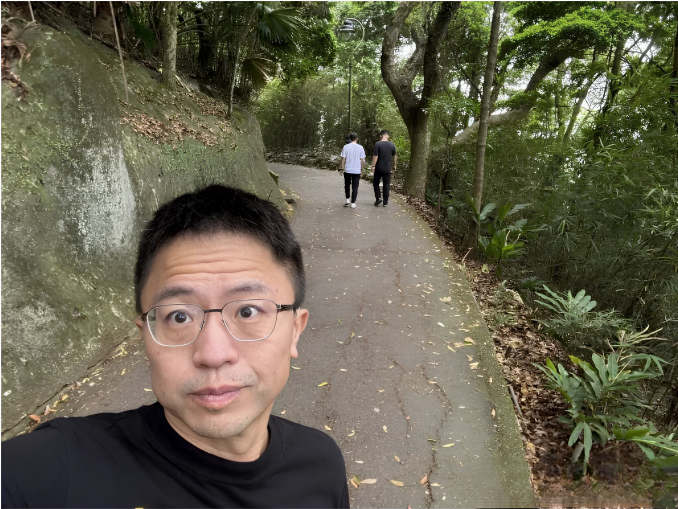
At first, I went alone, and then I started bringing my dog. Our dog is a bit delicate—it cannot handle extreme heat or tough hikes—so this shaded, flat, and scenic route was perfect.
Eventually, I began bringing friends there.
When people visit Hong Kong, they usually want to grab dinner, get drinks, or go shopping. I generally have little interest in that. Instead, I would say, "How about we go for a walk around the Peak?"
Later, when business associates or partners visited and asked where to meet, I would say, "If you don't mind, let's just meet on Lugard Road at the Peak."
Dressed casually, in walking shoes, we would chat as we walked. A 40-minute loop with great views keeps everyone relaxed.
I have always felt this is a wonderful way to hold a meeting.
03. My Familiar Hong Kong Routine: A Walk, Then a Seat at That Cafe
Near the starting point of the Lugard and Harlech loop, there is a restaurant I know well—I believe it's called The Peak Lookout.
I used to love that place.
It has both indoor and outdoor seating, and I remember they used to allow dogs, too. My routine was simple: take a walk around the Peak, and when the loop was done, sit down there for a while, order some food, and have a drink.
I went there so often that I memorized the menu and got to know the servers.
This is the daily Hong Kong routine I loved.
It is not the "I'm visiting for three days, where should I check in?" version of Hong Kong. It is the Hong Kong that slowly grows on you after you actually live there.
You develop your own regular route, a favorite table, a familiar cup of coffee, and stories you naturally tell when you bring friends along for a stroll.
For me, Hong Kong is not just Central, Causeway Bay, or Tsim Sha Tsui. Hong Kong is also Lugard Road, Harlech Road, the shaded path at the Peak, the place where I walked my dog, and the place where I chatted with friends on the go.
04. The Other End of the Hong Kong Trail: Dragon's Back and Big Wave Bay
The Hong Kong Trail is roughly 47 kilometers long, though officially it is often cited as 50 kilometers. It starts near the Peak and ends at Big Wave Bay.
If Lugard and Harlech Roads are the easiest, most stroll-friendly sections of the Hong Kong Trail, then Dragon's Back is the most famous part, perfect for everyday people wanting to experience the city's mountain and sea views.
I have hiked Dragon's Back many times—twenty, thirty, maybe even more.
The entire route is about 7.8 kilometers, and the elevation gain is not too demanding. As long as your knees are fine, even if you do not exercise much, I think you can easily give it a try. The toughest climb is mostly at the beginning; the rest is quite relaxing.
Why is Dragon's Back so famous?
One word: Beautiful.

Walking along the ridge, you can see mountains, the ocean, beaches, luxury residential areas, Repulse Bay, Stanley, and various other coves. Especially if you come from northern China, the first time you step onto that ridge, it is easy to think, "Wow, I had no idea Hong Kong had places like this."
That was exactly my reaction.
This is the most attractive thing about Hong Kong to me: it can be highly urban, but also highly natural; highly commercial, but also wild. You step out of the subway, bus, or taxi, walk a short distance, and suddenly enter an entirely different operating system for life.
05. Big Wave Bay: Yes, You Can Surf in Hong Kong
The end of Dragon's Back is Big Wave Bay. The end of the entire Hong Kong Trail is also Big Wave Bay.
Many people do not know that you can surf in Hong Kong.
I surf. Or more accurately, I have learned two types of surfing.
One is wakesurfing, where a boat goes ahead of you, and you ride the wake it creates.
During the pandemic, since Hong Kong was never fully locked down and I was bored staying in the city, I went out and learned wakesurfing. After about a dozen lessons, I could stand on the board and ride the wake for a kilometer or two without falling.
Wakesurfing is actually easier than it looks.
The truly difficult one is ocean surfing.
Big Wave Bay is a famous surfing spot in Hong Kong. In the winter, many people go there to surf, and I took quite a few lessons there myself. To be honest, I was not great at it. Real surfing is tough and nowhere near as glamorous as it appears. You get smashed by the waves over and over, end up bruised and battered, and then you paddle back out to keep practicing.
But I have so many great memories tied to Big Wave Bay.
After practicing, I would often sit at a seaside cafe and have a beer. The feeling is hard to describe: you are covered in salt water and sand, the beach is right in front of you, people are still surfing in the distance, and you are completely exhausted but in a fantastic mood.
On New Year's Day this year—January 1st—I put on a backpack and ran the entire Hong Kong Trail by myself. I finished at Big Wave Bay, went back to that familiar cafe, and ordered a beer fittingly named "Big Wave Bay."
Sitting there, watching people learn to surf on the beach, looking at the path coming down the mountain, so many memories came rushing back.
I realized that this is what the mountains of Hong Kong have given me.
It is not just scenery.
It is life, it is memories, it is the kind of relationship you only build with a place after you have walked its paths over and over again.
06. Not a Travel Guide, But a Lifestyle
So, if you ask me why I love Hong Kong, I probably won't start by talking about finance, education, shopping, or efficiency.
I will start with the mountains.
I will talk about that 3.8-kilometer trail at the Peak, walking my dog, inviting friends for a hike instead of dinner, the mountain and sea views at Dragon's Back, surfing at Big Wave Bay, and that beer after running the Hong Kong Trail.
Because that is the Hong Kong I actually lived in.
It is not the stereotypical Hong Kong. It is not just concrete, money, crowding, and stress.
It has mountains, the sea, the breeze, the shade of trees, cafes, surfboards, night trail runners, and moments where you can sit alone by the water and just space out.
I love Hong Kong largely because it makes me believe that a city can be highly efficient yet deeply natural; pragmatic yet romantic; a place where you can work tirelessly, and then simply turn around and walk into the mountains.
This is the Hong Kong in my eyes.
In the next article, I want to talk about the MacLehose Trail. That is where I ran my first 100-kilometer race, and where I truly understood a phrase that means a lot to me in life:
Journey is the reward.
Disclaimer: Any reference to 'Hong Kong' on this website refers to the Hong Kong Special Administrative Region(Hong Kong SAR).


Comments