.png)
US OPT Policy May Undergo Major Changes: International Students May Face the Dilemma of Paying Exorbitant Fees Before They Can Work
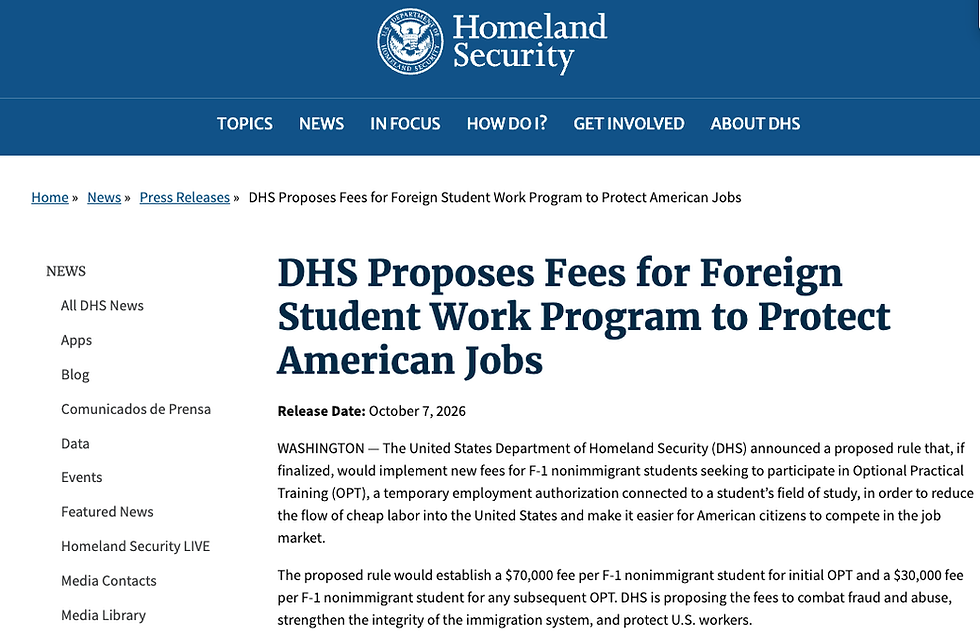
Recently, the U.S. Department of Homeland Security (DHS) proposed a new draft rule targeting OPT (Optional Practical Training for international students after graduation). It has been published in the Federal Register and entered a 30-day public comment period. If the proposal is ultimately implemented, it will have a profound impact on international students' paths to staying in the United States.
As a professional institution deeply engaged in the U.S. immigration field, Globevisa is here to sort out the key points of the new rule, the official rationale, and possible response strategies for you.
I. Core Change: A Sharp Increase in OPT Application Fees
According to the proposal, DHS plans to introduce high administrative fees for the OPT recommendation process:
● First-time OPT application: universities would need to pay USD 70,000
● Subsequent recommendations or STEM extensions: USD 30,000 each time
This means that for a STEM student completing the full process from 12 months of regular OPT to a 24-month extension, the school would cumulatively need to pay up to USD 130,000.
Key implementation details:
1. The paying entity is the university: the school's DSO must first pay the government before it can complete the OPT recommendation entry in the SEVIS system. If the fee is not paid, the student cannot obtain the OPT recommendation, and USCIS cannot adjudicate the EAD work permit, which would prevent the student from working legally.
2. Costs can be passed on: the rule allows universities to pass the full cost on to international students themselves or employers. Therefore, the final sky-high bill of USD 100,000 may still end up being paid by the international student.
3. Other notes: if the EAD is denied, the school may apply for a refund; the new rule has no retroactive effect, and OPT already approved before the new rule takes effect will not be affected.
Since most universities cannot absorb this cost on their own, once they are unable to pass it on, they may choose to tighten or even cancel OPT recommendations. By raising the threshold in this way, forcing universities to reduce OPT quotas, or causing international students and employers to give up on OPT due to rising costs, this practice is essentially a disguised restriction on the OPT program.
II. Official Motivation: Closing the "Back Door" and Raising the Threshold
DHS explicitly stated in its press release that OPT should not become a "back door" into the U.S. labor market, a subsidy for cheap labor, or a reward for exploiting loopholes. The official cited tens of thousands of OPT fraud cases in recent years as the reason, emphasizing stronger anti-fraud and compliance oversight.
At the same time, this policy, together with measures such as the USD 100,000 additional fee on H-1B, forms a combined punch aimed at closing the path for employers to avoid H-1B employment costs by hiring OPT students. Once all these policies are implemented, international students may have to pay about USD 200,000 for a job before they even have one.
Although industry observers expect universities and companies may file lawsuits, OPT relies on DHS administrative regulations, and this time the NPRM procedure under the Administrative Procedure Act has been followed. The determination of the executive branch to push this forward should not be underestimated. Once implemented, international students, universities, and employers will all be affected.
III. Multi-Party Impact: International Students, Universities, and Employers Are All Affected
According to Open Doors data, in the 2024-2025 academic year, more than 294,000 students across the United States participated in OPT, accounting for about one quarter of the total international student population.

For international students: regardless of who bears the cost, the economic pressure of tens of thousands of dollars further raises the threshold for finding work in the United States.
For universities: schools that rely on international student tuition may be forced to reassess or even reduce OPT recommendation quotas.
For employers: combined with factors such as the difficulty of the H-1B lottery and higher wage standards, the overall cost and uncertainty of hiring international graduates have reached historic highs.
In other words, before international students even secure a job, they may face an additional cost of USD 100,000 to USD 200,000.
IV. Response Recommendations: Break Away from a Single Path and Plan Alternatives in Advance
In the face of gradually tightening U.S. immigration policies, students and parents are advised to remain calm, but they need to break away from reliance on the single path of "study → OPT → H-1B → green card."
Short-term response: the proposal is still in the public comment period, and the current OPT order remains unchanged. Students who are already studying or about to graduate should seize the current policy window and strengthen their internship experience as early as possible.
Long-term planning: as the uncertainty of the traditional "lottery + employer sponsorship" channel increases, more and more families are beginning to choose a "multi-track backup" identity planning strategy, such as using the new EB-5 law to carry out asset and identity separation in advance.
Against this backdrop, choosing a professional institution familiar with U.S. immigration laws and with extensive practical experience is particularly important. Globevisa has been deeply engaged in U.S. immigration for more than 15 years and has helped more than 5,000 families apply for U.S. green cards. Since the launch of the new EB-5 law in 2022, it has successfully assisted in raising funds for more than 25 EB-5 projects. We have a mature EB-5 project screening and documentation team and can tailor identity planning solutions according to each family's situation, helping international students efficiently complete their arrangements within the policy window.
How Does the New EB-5 Law Build a "Safe Harbor" for International Students?
Against the backdrop of persistently low H-1B lottery odds and the prospect of soaring OPT costs, the new EB-5 investment immigration law, with its institutional advantages, has become the core solution for many families of students in the United States seeking "identity autonomy":
1. Break free from employer binding and the H-1B lottery: EB-5, as a green card application route independent of work visas, requires no employer sponsorship and no participation in the H-1B lottery, fundamentally eliminating workplace identity shackles.
2. Domestic "concurrent filing" dividend: while in the United States with valid F-1 status, and when the EB-5 new law reserved projects are still current, one can simultaneously file the I-526E immigrant petition and the I-485 application to adjust status. During adjudication, the EAD work permit and AP re-entry permit can be approved at the same time (the combined card is the Combo Card). Filing allows one to legally remain in the United States. After holding the EAD work permit, finding a job no longer requires employer sponsorship or payment of high additional costs, allowing free choice of employment, job changes, and even entrepreneurship; together with the AP re-entry permit, one can freely enter and exit the country and say goodbye to visa anxiety
In an external policy environment that is changing rapidly, rather than struggling to break through in a continuously tightening channel, it is better to plan ahead for the long term and use certain identity planning to protect your studies and career.


Comments