
South Korea Immigrant investor Scheme: Tered Investment Thresholds Explained
Korean investment immigration has long been a popular choice among high-net-worth individuals seeking overseas residency, thanks to its geographical proximity, clear investment pathways, and well-defined status conversion mechanisms. Currently, Korean investment immigration is mainly divided into two categories: Public Interest Investment Immigration (Deposit Program) and Tourism and Leisure Facility Investment Immigration (Property Investment Program).
It is important to note that South Korea’s current investment immigration policy has no age limit. The previous retirement investment immigration program for applicants aged 55 and above was abolished in 2023 and can no longer be used for planning based on the former policy of “KRW 300 million for applicants aged 55 and above.”
I. Public Interest Investment Immigration (Deposit Program)
This program allows applicants to obtain residency by making an interest-free, principal-protected investment in a fund designated by the Korean government. It offers a high level of capital security and is particularly favored by conservative investors seeking stable investment arrangements. Depending on the investment amount, there are two pathways:
1. General Investment Immigration
The investment threshold for general investment immigration is KRW 1.5 billion or more. The investor, spouse, and unmarried children can obtain F-2 residency status as accompanying family members. After maintaining the investment for five years, the applicant can apply to convert to F-5 permanent residency. After the conversion to permanent residency, the investment principal can be fully returned without interest, while the F-5 status can be maintained permanently.
2. High-Value Investment Immigration
If the investment budget reaches KRW 3 billion or more, the high-value investment immigration pathway may be considered. The investment threshold for this pathway is KRW 3 billion or more. The investor, spouse, and unmarried children can directly apply for F-5 status, subject to the condition of maintaining the investment for more than five years.
Compared with the general KRW 1.5 billion investment pathway, the key feature of the KRW 3 billion high-value investment immigration pathway is that applicants can obtain F-5 permanent residency directly, rather than first obtaining F-2 status under the general investment immigration pathway and then converting to F-5.
It is important to note that “direct F-5 permanent residency with KRW 3 billion” is likewise subject to the mandatory requirement of maintaining the investment for five years. If the investment is withdrawn before the five-year period is completed, the permanent residency status already obtained may be cancelled.

II. Tourism and Leisure Facility Investment Immigration (Property Investment Program)
The Korean Ministry of Justice has adjusted the former “Real Estate Investment Immigration System” to the “Tourism and Leisure Facility Investment Immigration System” and raised the investment threshold to KRW 1 billion. This program applies to eligible tourism and leisure facilities and other designated investment targets located in areas designated by the Minister of Justice. It does not mean that purchasing an ordinary residential property in South Korea is sufficient to obtain investment immigration status. Eligible investors can obtain F-2 residency status and, after meeting the investment maintenance and other applicable requirements, apply for F-5 permanent residency.
Therefore, when selecting the KRW 1 billion property investment pathway, the key considerations are not limited to whether the property price reaches KRW 1 billion. They also include the investment location, project eligibility, property title and transaction status, as well as subsequent residency arrangements and exit options.
The compliant properties in Jeju Island, South Korea, selected by Globevisa, have freehold ownership, are fully furnished and ready for occupancy, and have high occupancy rates. Our project selection process is not based solely on the investment amount. Instead, we comprehensively assess project compliance, property ownership, sales qualifications, property value, historical transactions, regional conditions, and subsequent exit conditions.
Our local Korean team assists clients with property selection, contracts, payment, title transfer, and immigration applications, with Globevisa providing support throughout the entire process. The property investment not only secures a freehold asset, but also allows investors to choose freely after five years between selling the property for liquidity or continuing to earn rental income, creating a dual-track approach to residency planning and asset allocation.
III. How Should You Choose a Korean Investment Immigration Pathway in 2026?
Different investment options correspond to different capital preferences and residency objectives.
If capital security and ease of subsequent management are the primary concerns, the KRW 1.5 billion general public-interest investment pathway may be worth considering. If the investment budget is sufficient and the goal is to enter the F-5 permanent residency pathway directly, the KRW 3 billion high-value investment immigration pathway may be considered.
If the preference is to hold Korean real estate while also taking into account residential use and asset allocation, the KRW 1 billion Tourism and Leisure Facility Investment Immigration pathway may be further explored. However, it is essential to verify whether the specific project falls within the current scope designated by the Korean Ministry of Justice.
Therefore, there is no single “optimal solution” under Korean investment immigration that is suitable for everyone. The appropriate pathway should be determined comprehensively based on the investment budget, asset preferences, family circumstances, residency objectives, and future exit plans.
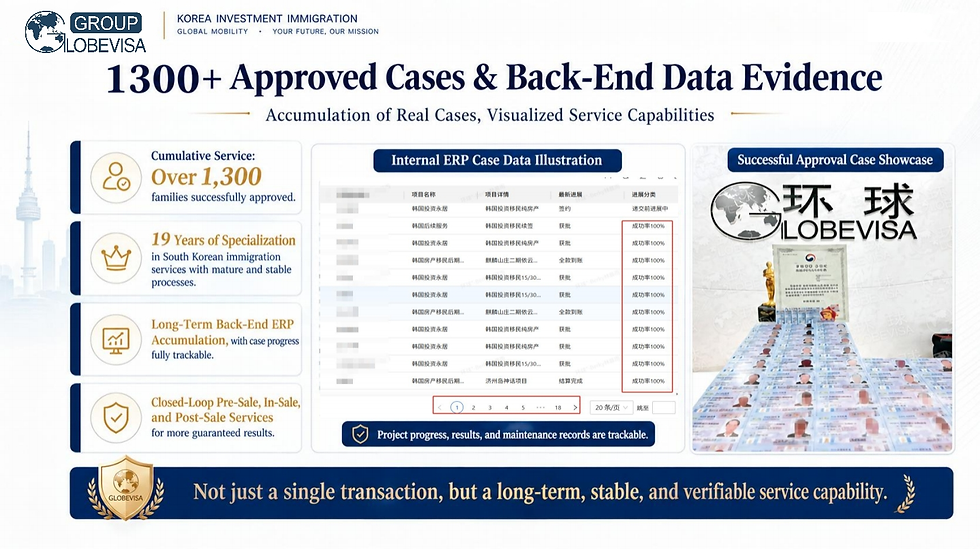
Since 2013, Globevisa has been deeply engaged in Korean investment immigration for 13 years, during which we have helped more than 1,300 families obtain Korean F-2/F-5 status. Rather than recommending programs based solely on the investment amount, we begin with each client’s residency objectives and provide long-term, comprehensive planning covering investment project selection, application requirements, and subsequent status maintenance.
From initial program matching, property purchase and contract signing, to F-2 approval, landing reminders and transition guidance, and then to subsequent status renewal and F-5 permanent residency conversion, as well as property management, rental, and sale arrangements, Globevisa provides full-lifecycle, dedicated service support, ensuring a well-coordinated connection between residency planning and asset allocation.


Comments