.png)
A Shortcut to World-Class Education: Why Japan is the New Choice for Southeast Asian Families
In Southeast Asia, whether it’s the pressure of the PSLE in Singapore or the skyrocketing tuition fees of international schools in Thailand, Vietnam, and Malaysia, parents are feeling the heat. Instead of pushing your child into the local 'rat race' or sending them across the globe to face cultural barriers in the West, more and more families are looking toward Japan.
As the world’s third-largest economy, Japan offers a mature, world-class international education system. Compared to the US or Europe, Japan is a tangible, manageable, and affordable springboard to top-tier education. With direct flights taking only 4 to 7 hours and a minimal 1-2 hour time difference, you can secure your child’s future without sacrificing your business, network, or lifestyle in Southeast Asia.
1. Elite Early Education: Quality Schooling Right at Your Doorstep
Early childhood is the golden period for language acquisition and character building. For families who value quality time, Japan eliminates the pain of 'separation for study.' Weekend visits are easy, allowing your child to grow in a loving, global environment.
Tuition-Free Punblic Educatio & Elite Quality
Once you obtain a legal long-term residency status in Japan, your children can access the local public education system. Kindergarten, Primary, and Junior High School are all tuition-free. Major cities even provide subsidies for textbooks and school meals, leaving only minimal administrative fees.
Compared to the high costs of local international schools in SEA or the US/UK, Japan offers a high-standard, low-cost elite education. It’s all about the "Whole-Person" approach: small class sizes, personalized attention, and a curriculum that balances logic, hands-on skills, and the famous Japanese etiquette. Plus, with an immersive Japanese-English bilingual environment, your child won't just learn a language—they'll gain a truly global edge and a international mindset from day one. High-quality education doesn't have to break the bank.

A Safe & Nurturing Haven for Young Learners
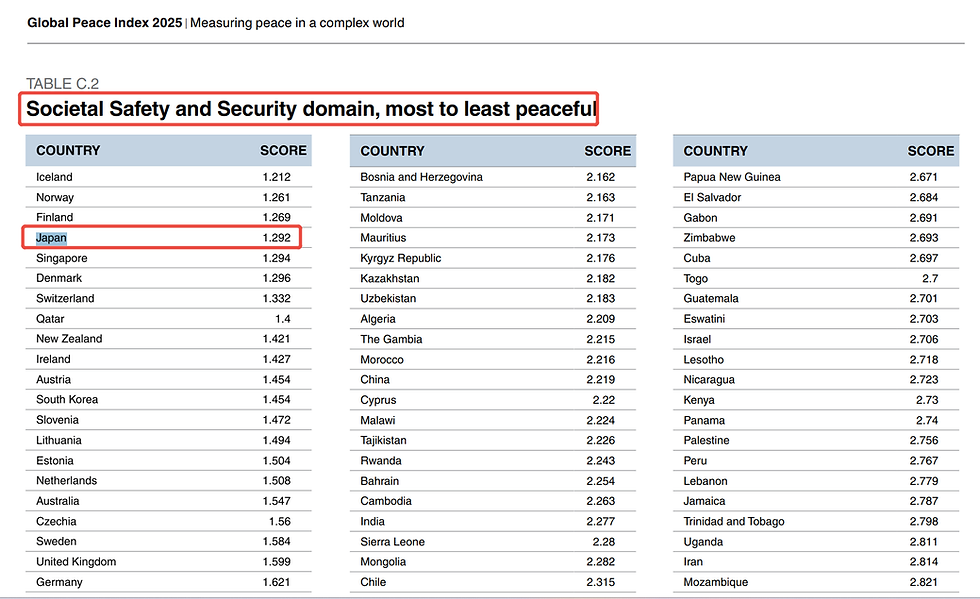
When it comes to overseas education, safety is always the #1 priority. Japan consistently ranks among the safest nations globally. According to the 2025 Global Peace Index (GPI), Japan is ranked 4th worldwide for societal safety and security.
Beyond rankings, Japan offers a cultural affinity that Southeast Asian families value. With similar lifestyle habits, diets, and social etiquette, your child won't face a harsh "culture shock." The seamless transition allows them to integrate into school life quickly and happily. With Japan’s rigorous campus security and student-centric environment, parents can truly enjoy total peace of mind.
2. Higher Education: A Bridge to Global Prestige
Japan’s higher education is a global powerhouse. Home to the prestigious 7 Imperial Universities (including the University of Tokyo and Kyoto University) and world-renowned private institutions like Waseda and Keio, Japan offers an elite academic environment.
With over 30 Nobel Prize laureates—the highest in Asia—Japan’s research capabilities are second to none. This "hardcore" academic foundation ensures a high-value degree that is recognized worldwide. For ambitious students in Southeast Asia, a Japanese education is the ultimate springboard to the world’s top-tier universities and global career opportunities.
Abundant Top-Tier Resources: A Strategic Shortcut to Success
With over 700 universities and nearly 50 ranking in the QS Global Top 500, Japan’s expertise in STEM, Business, and Arts is world-leading. Unlike the brutal competition for Ivy League or Oxbridge spots, holding a Japanese residency status allows students to bypass the narrow "International Student" quota, significantly increasing their acceptance rate into elite universities. In 2026, MEXT (Japan’s Ministry of Education) is further expanding enrollment and boosting scholarships, making Japanese higher education a high-value, low-stress "premium track" for ambitious students.

Global Synergy: Seamless Transition to the World’s Best
Through the SGU (Top Global University Project), 37 elite Japanese universities offer 100% English-taught programs—no Japanese language proficiency required. The curriculum and assessment standards are perfectly aligned with Western Ivy League schools, and the degrees are recognized globally. Moreover, deep partnerships with icons like Yale, Oxford, and Stanford allow students to participate in exchange programs at a fraction of the cost. Pay Japanese tuition, yet enjoy world-class resources from the US and UK. It’s truly "Study in Asia, Connect to the World."

Limitless Career Horizons: A Dual-Advantage for the Future
As the world’s 3rd largest economy, Japan is hungry for global talent. Graduates with Japanese residency can transition directly into the workforce without the usual bureaucratic hurdles of work visa approvals. Furthermore, given the massive footprint of Japanese MNCs across Southeast Asia, a degree from a top Japanese university is a gold-standard credential for leading multinational firms and research institutions back home. Whether staying in Japan or returning to SEA, your child’s future is secured.
3. Secure a Japanese Long-Term Residency: Unlock Exclusive Benefits and a Winning Future
The true power of a Japanese education lies in holding a legal long-term residency. This status allows your child to transcend the limitations of being an "International Student," enjoying the same world-class benefits as Japanese citizens. From early childhood to higher education, it is a smarter, more cost-effective, and highly efficient strategic investment.
Level Up with National-Level Benefits
With a long-term residency, your spouse and children can join you via a Dependent Visa, allowing the family to settle or travel freely between SEA and Japan. Your children gain equal rights to local students: free public education, priority admission, and shared resources—completely bypassing international student quotas.

A Unique Profile for Ivy League & G5 Admissions
Top universities value diversity. A student with a Southeast Asian background + Japanese international education + Trilingual skills (Native + English + Japanese) perfectly fits the "Global Talent" criteria for elite schools like the Ivy League or UK’s G5. Furthermore, getting a recommendation letter from a Nobel-level professor in Japan provides a massive competitive edge that ordinary study-abroad profiles simply cannot match.
The Gateway: Two Fast-Track Paths for SEA Elite Families
You don’t need to relocate permanently or speak Japanese to secure this future. Choose the path that fits your lifestyle:
● Business Manager Visa:
○ Low Barrier: No language, age, or medical exam requirements.
○ High Flexibility: Fast processing and a smooth path to Permanent Residency (PR).
● Highly Skilled Professional (HSP) Visa:
○ Speed: Secure a 5-year residency for the whole family in as little as 6–8 months.
○ Fast-Track PR: Eligible to apply for PR in as little as 1 year.
One status, a lifetime of rewards. From education and healthcare to global career mobility, this is the ultimate "low-input, high-return" path for your family.
From bilingual enlightenment and character building in early years to elite university admissions and global career mobility, Japan offers an unbeatable "Value-for-Money" track for Southeast Asian families. It is the ultimate solution for those seeking high returns with low stress and zero family separation. Located just a short flight from Southeast Asia, Japan is a safe, civilized haven with world-class resources. You don’t have to sacrifice your career to give your child a "Winning Identity."


Comments