.png)
UK Work Visas Are Cooling — So Why Is This Visa Surging Against the Trend?
- jeromexu
- 18 hours ago
- 6 min read
On 27 August 2026, the UK Home Office released its latest immigration statistics for the second quarter of 2026.In the year ending June 2026, the number of UK work visas granted fell by 18% year on year. Compared with the peak recorded at the end of 2023, the figure was down by an even more striking 62%. Against a backdrop of higher salary thresholds for Skilled Worker visas, a narrower range of eligible occupations and tighter sponsor compliance requirements, the direction of UK employment-based immigration policy has become increasingly clear: the system is becoming more selective.
Yet against this broader slowdown, one visa route is moving firmly in the opposite direction.
The UK Global Talent Visa (GTV) delivered an exceptionally strong performance in Q2 2026, with overseas main-applicant applications reaching the highest level ever recorded for a second quarter. As conventional work visas become increasingly dependent on employers, eligible occupations and salary thresholds, more highly accomplished professionals are turning their attention to a UK immigration route driven by something very different: their own expertise, achievements and professional value.
01 Global Applications Hit a Record Q2 High — While Approval Rates Remain Exceptionally Strong
📊 Demand for the Global Talent Visa is accelerating
In Q2 2026, the number of overseas Global Talent Visa applications from main applicants reached 1,128:
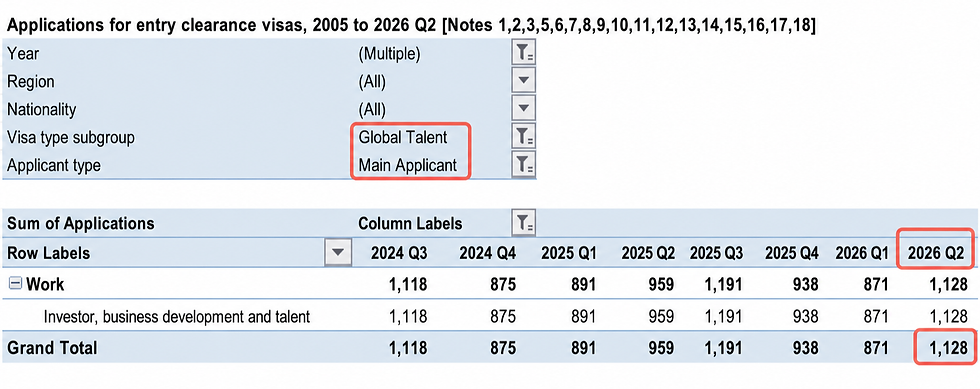
Compared with 871 applications in Q1 2026, this represents an increase of 257 applications, or 29.5% quarter on quarter.
Compared with 959 applications in Q2 2025, the number was also up by 17.6%.
This is more than a routine quarterly rebound. It marks the highest number of GTV applications ever recorded in a second quarter since the route was launched.

From just 30 applications to 1,128, the Global Talent Visa has evolved in only a few years from a relatively niche immigration category into one of the UK’s key routes for attracting internationally recognised talent.The message behind the data is becoming increasingly clear: The UK has not closed its doors to global talent. It is becoming more selective about the type of talent it wants to attract. The opportunities are increasingly being directed towards individuals who can demonstrate genuine technical expertise, research value, commercial contribution and industry influence. While many traditional work visa routes continue to narrow, globally competitive professionals are increasingly turning towards the Global Talent route.
🛡️A 99% approval rate at the visa stage
Strong application growth has not come at the expense of approval rates. In Q2 2026, only 14 Global Talent Visa applications were recorded as refused, producing an approval rate of approximately 99.13%. This highlights one of the route’s most attractive characteristics: once applicants reach the visa stage, outcomes remain exceptionally strong. By comparison, Skilled Worker Visa applicants can be exposed to a range of employer-related risks, including sponsor licence suspension or revocation, scrutiny over the genuineness of the role, failure to meet salary requirements, or changes to the sponsorship relationship.The Global Talent Visa removes much of that dependency. For applicants who have already secured the required endorsement, the subsequent visa stage can be considerably more straightforward.

02 It Is Not Just the Initial Visa — Extensions Are Even More Reassuring
A common concern among applicants is what happens after the first Global Talent Visa is granted. Will they have to undergo another intensive talent assessment when extending their visa? Could new hurdles suddenly appear when they later apply for settlement?
The latest data provides a highly encouraging answer. In Q2 2026, 2,452 Global Talent Visa extensions were approved, while only 9 were refused. That equates to an extension approval rate of approximately 99.63%.

These figures provide powerful evidence of the long-term stability of the Global Talent route.
Once an applicant has successfully secured endorsement and been granted the visa, there is no requirement to undergo the same talent assessment again when applying for an extension. Instead, the focus shifts to whether the applicant continues to meet the relevant immigration requirements, including demonstrating qualifying earnings in the UK from work related to their endorsed field.
In that sense, extension is primarily about demonstrating continued eligibility and compliance, rather than competing for Global Talent status all over again. Settlement follows the same general principle, although applicants must also satisfy the applicable residence, English-language and Life in the UK requirements.
03 Settlement in as Little as Three Years — A Clear Route to UK ILR
One of the strongest advantages of the Global Talent Visa is not simply that it removes the need for employer sponsorship. It also offers a clear and established pathway to UK settlement. Depending on the applicant’s field and endorsement category, eligible Global Talent Visa holders may qualify for Indefinite Leave to Remain (ILR) after either three or five years.
For example, applicants endorsed under qualifying Exceptional Talent categories, as well as certain eligible applicants under the academic and research routes, may be able to apply for ILR after just three years. Compared with the traditional Skilled Worker route, the Global Talent Visa offers several major advantages:
✅No employer sponsorship required
Applicants do not need a UK employer to hold a sponsor licence, nor do they need to secure a specific sponsored job offer before applying.
✅No dependence on a single employer
Global Talent Visa holders can work as employees, establish a business, work on a self-employed basis, or move between companies as their career develops.
✅No universal minimum salary threshold
Eligibility is based primarily on the applicant’s professional achievements, recognition and value within their field — rather than whether they meet one standardised minimum annual salary.
✅Partner and children can accompany the applicant
In Q2 2026 alone, 647 visas were granted to dependants of Global Talent applicants and visa holders. For many families, the Global Talent Visa therefore represents far more than an individual career opportunity. It can become the starting point for a wider plan involving UK residence, children’s education and long-term family settlement.
✅Settlement possible in as little as three years
Eligible applicants can qualify for ILR through either the three-year or five-year route, providing a much clearer framework for long-term life in the UK.
At a time when access to conventional UK work visas is becoming increasingly restrictive, an immigration status that is not tied to one employer, can be supported by an individual’s own achievements, and offers a defined route to settlement is becoming increasingly valuable.

04 Why Is the Global Talent Visa Growing Against the Trend?
The surge in applications is not accidental. It reflects a broader shift in the UK’s strategy for attracting international talent. While overseas recruitment into more conventional roles is being tightened, demand for talent in areas such as artificial intelligence, digital technology, biotechnology, quantum technologies, advanced manufacturing, academic research and the creative industries remains strong. The UK is not simply looking for people who can fill individual vacancies. It is increasingly competing for people who can create long-term value for its industries, research institutions and innovation ecosystem. The Global Talent Visa is one of the clearest expressions of that strategy.
Rather than asking whether an applicant already holds an ordinary UK job offer, the route focuses on questions such as:
● Have they already produced valuable professional or academic achievements?
● Have they received recognition from experts or respected organisations within their field?
● Have they made a tangible impact on their industry, company or research area?
● Do they have the ability and potential to continue developing their career in the UK?
The logic behind a traditional sponsored work visa is essentially: “First, find a UK employer willing to sponsor you.” The logic behind the Global Talent Visa is fundamentally different:
“You have already demonstrated your value through years of professional achievement — now your own track record can become the foundation for building your future in the UK.”
That distinction helps explain why Global Talent continues to grow even while the broader UK work visa market is contracting.
Conclusion: A New Window of Opportunity for Global Talent
The Q2 2026 figures tell a compelling story. Global Talent Visa main-applicant applications rose 29.5% quarter on quarter, reaching the highest level ever recorded for a second quarter, while the visa extension approval rate reached approximately 99.63%.
Taken together, the application, approval and extension data point towards the same conclusion: At a time when the UK is tightening many conventional employment-based immigration routes, the Global Talent Visa remains one of the few UK pathways continuing to demonstrate growth, flexibility and long-term stability. The real opportunity does not come from the eligibility threshold suddenly becoming easier.
It comes from the fact that the profile of talent the UK wants to attract is becoming increasingly clear.
For professionals in academic research, arts and culture, or digital technology, now is the time to review your career portfolio, identify the most appropriate Global Talent pathway, and strengthen the evidence that could ultimately determine the outcome of an endorsement application.
Rather than waiting on the sidelines as other immigration routes continue to change, the Global Talent Visa offers a way to turn years of professional achievement into a platform for your next stage of growth — and a new starting point for your family’s long-term future in the UK.


Comments