.png)
No Points, No Quotas: New Zealand's Green List Remains the Ultimate Favorite
- Henry Fan
- 18 hours ago
- 4 min read
Lately, there's been a fair bit of movement in New Zealand's immigration policy.
From June 1, English language requirements for the Accredited Employer Work Visa were extended to ANZSCO Level 3 roles, covering hospitality and trades positions. Investment migration also saw some tweaks – investors can now put part of their minimum investment toward charitable donations.

And the changes keep coming. As scheduled, August 24 will bring a more systematic overhaul to the Skilled Migrant Category – new residence pathways, new wage calculation methods, all landing at once.
Amid all this flux, though, one pathway has stayed remarkably steady – and has remained hugely popular throughout: New Zealand's Skilled Migration (Green List).
Unlike the 6-Point System, which requires you to crunch numbers and add up scores, the Green List runs on refreshingly simple logic: Is your occupation on the list? Yes? Got an accredited employer job offer and meet the criteria? Then apply directly. No points-scoring, no waiting in line for a quota spot.
To put it plainly: this is an express lane where "if your profession fits, you're on board."
I. What exactly is the Green List? Two tiers, two pathways
The Green List is a dedicated stream Immigration New Zealand launched back in 2022 to attract highly skilled talent in globally in-demand fields. It covers over 200 long-term skill shortage occupations across engineering, IT, healthcare, construction, education, agriculture, and more.
It's split into two tiers:
● Tier 1 (Direct-to-Residence): If your occupation is on the Tier 1 list, you can apply for a resident visa directly once you have a full-time job offer from an accredited employer – no need to start working in New Zealand first. Currently, Tier 1 covers around 174 occupations. Immigration NZ processes these applications at the highest priority level.
● Tier 2 (Work-to-Residence): If your occupation is on the Tier 2 list, you'll need to enter New Zealand on an accredited employer work visa, work full-time in that Tier 2 role for 24 months, and then you can apply for residence. Currently, Tier 2 covers about 40 occupations.
II. Why does the Green List deserve your attention?
No points required, exceptionally high certainty. This is the Green List's biggest draw. No calculating whether your qualifications, income, and work experience add up to 6 points. Just check: is your job on the list? Do you have a qualifying offer? That's it. For applicants, this means far less mental gymnastics and a much smoother ride.
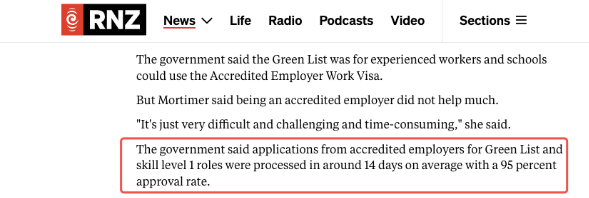
Extremely high approval rates, top-priority processing. A 95% approval rate is rare among major移民 destinations. Green List applications are given the highest processing priority by Immigration NZ, with Tier 1 cases typically turning around in 1–3 months.
Simpler hiring for employers – easier for you to get an offer. Accredited employers hiring for Green List roles are exempt from the usual "test the local labour market" advertising requirement. That cuts recruitment time and costs significantly, making employers more willing to extend offers to qualified overseas candidates.
No quotas – apply whenever you're ready. The Green List has no annual cap. Meet the conditions, and you can submit your application at any time.
III. Which occupations are on the Green List?
The Green List covers a wide range of industries, with the main categories being:
● Engineering & Construction: Structural engineers, civil engineers, electrical engineers, construction project managers, quantity surveyors, and more
● Healthcare: Registered nurses, specialist doctors, midwives, medical laboratory scientists, physiotherapists, and more
● IT & Communications: Software engineers, ICT security consultants, data analysts, cybersecurity specialists, and more
● Education: Primary school teachers, secondary school teachers
● Trades: Welders, metal fabricators, automotive panel beaters, spray painters, and more (newly added to Tier 2 from August 2025)
IV. Quick overview of eligibility requirements
Whether you're applying under Tier 1 or Tier 2, you'll need to meet these basic criteria:
● Age: 55 or under
● English language: IELTS 6.5 overall (Academic or General Training), or equivalent PTE 58 or TOEFL 79. A bachelor's degree or higher from an English-speaking country (US, UK, Canada, Australia, NZ, or Ireland) usually exempts you from this requirement.
● Skilled employment: A full-time job offer (at least 30 hours/week) from an accredited NZ employer, with a permanent contract or a fixed-term contract of at least 12 months
● Salary: Must meet the Green List salary threshold for that occupation; if no specific threshold applies, the median wage applies
● Health & character: Pass medical checks and provide police clearance certificates
● Tier 2 extra requirement: You must have already worked in a Tier 2 Green List occupation in New Zealand for a cumulative 24 months, and hold a valid work visa at the time of your residence application
V. Is now a good time to apply?
The occupation list is growing. Since its launch in 2022, the Green List has been steadily expanding. In 2025, teaching roles were upgraded from Tier 2 to Tier 1, and 10 new trades occupations were added. A wider list means more people can take this route.
High application certainty. 95% approval rates, manageable processing times, and no quotas – that combination is rare in today's global immigration landscape.
Policy stability. The Green List's core framework has remained consistent. In an environment where immigration policies are frequently shifting, this "steady as she goes" approach is itself a valuable dividend.
Final thoughts
The logic behind New Zealand's Skilled Migration (Green List) is refreshingly straightforward: if your occupation is on the list, you land a full-time job with an accredited employer, and you meet the criteria – you apply.
No points. No competitive ranking. No waiting for a quota slot.
For those who've already built up professional experience and credentials in fields like engineering, IT, healthcare, construction, or education, the Green List may well be one of the shortest, most certain pathways on the table among major immigration destinations right now.


Comments